

Every teammate in ThriveDesk has one of three roles: Account Owner, Administrator, or User. On the Roles & Permission page, you choose what the Administrator role and the User role can do. To give one teammate more or less than their role, use the Capabilities tab on that teammate's profile, because a setting there wins over the role.
settings.permissions:write, to open the page · Who has it by default: Account Owner and AdministratorsBefore you begin
You are the Account Owner or an Administrator. Administrators can change the User role. Only the Account Owner can change the Administrator role.
To change what one teammate can do, that teammate has already joined your workspace.
Where to find it
Settings → Roles & Permission. The item is in the Workspace group of the Settings sidebar, after Teammates.
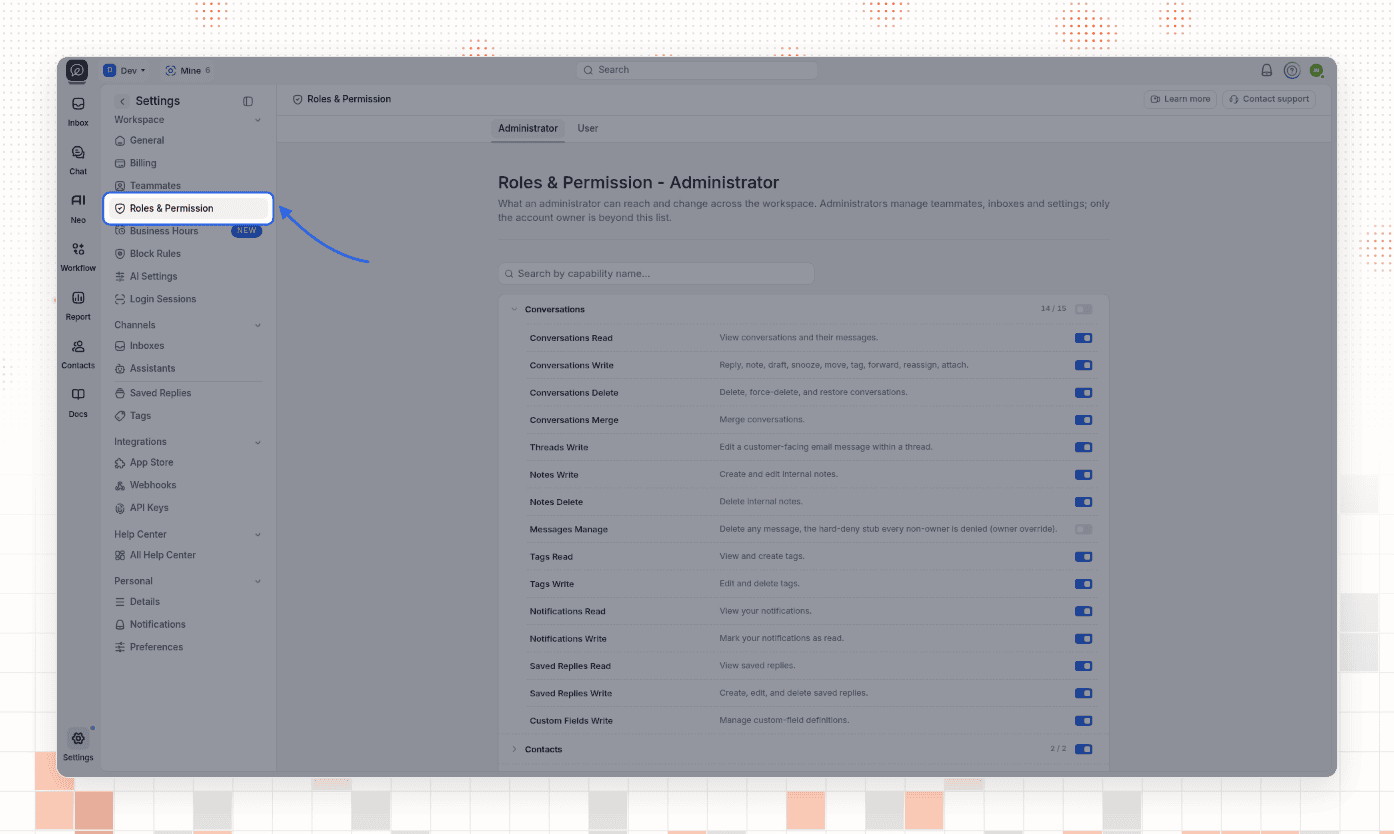
The three roles
Role | Who it is for | On the Roles & Permission page |
|---|---|---|
Account Owner | One person per workspace | No tab. The Account Owner always holds every capability. |
Administrator | People who manage teammates, inboxes, and settings | The Administrator tab. Only the Account Owner can change the role. |
User | People who work on conversations | The User tab. The Account Owner and Administrators can change the role. |
The three roles are fixed. You cannot add, rename, duplicate, or delete a role.
Change what a role can do
Go to Settings → Roles & Permission. The page opens on the Administrator tab.
Select the tab of the role you want to change: Administrator or User.
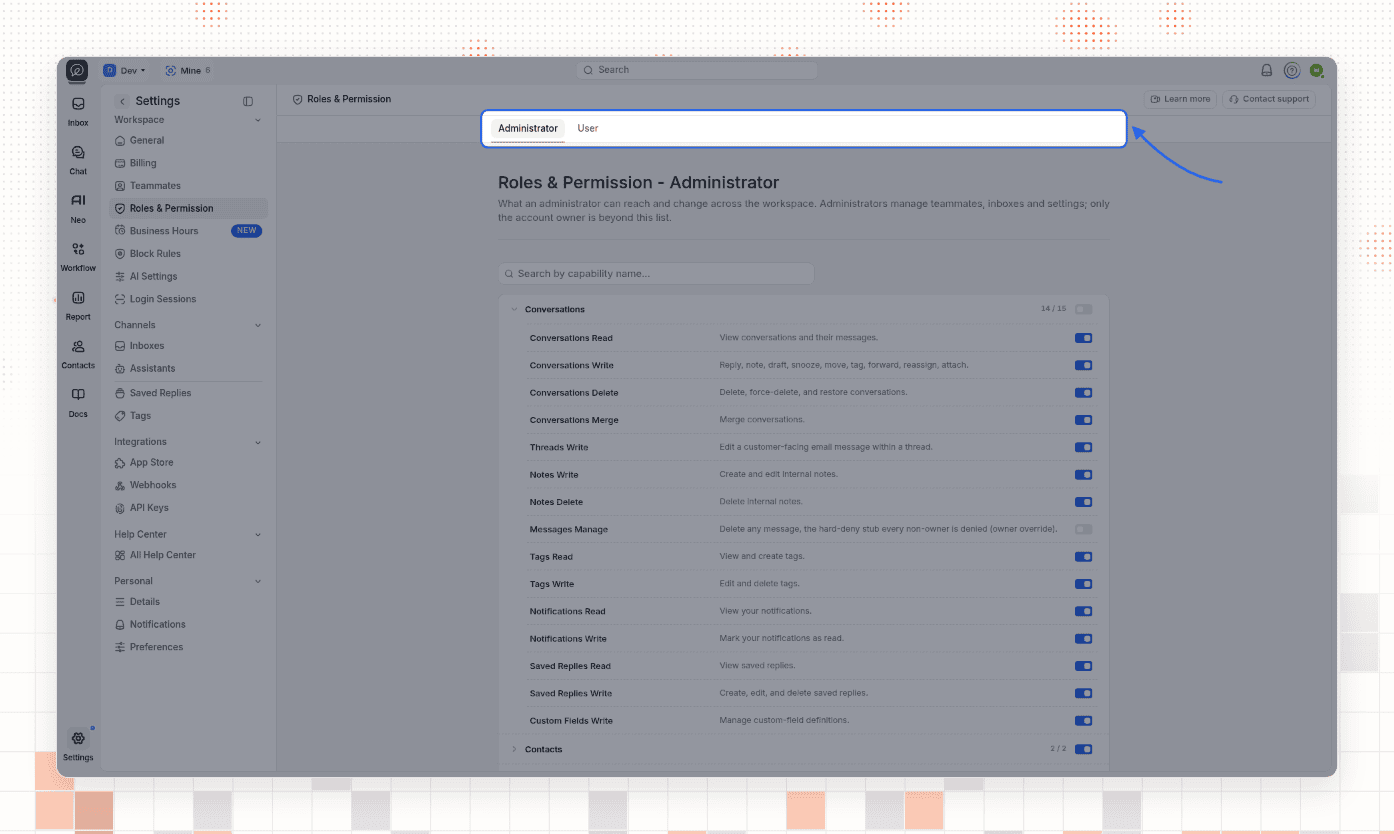
Each tab lists the capabilities in categories. Conversations starts open. Select any other category header to open that category. Each row shows the name of a capability, a short description, and a switch.
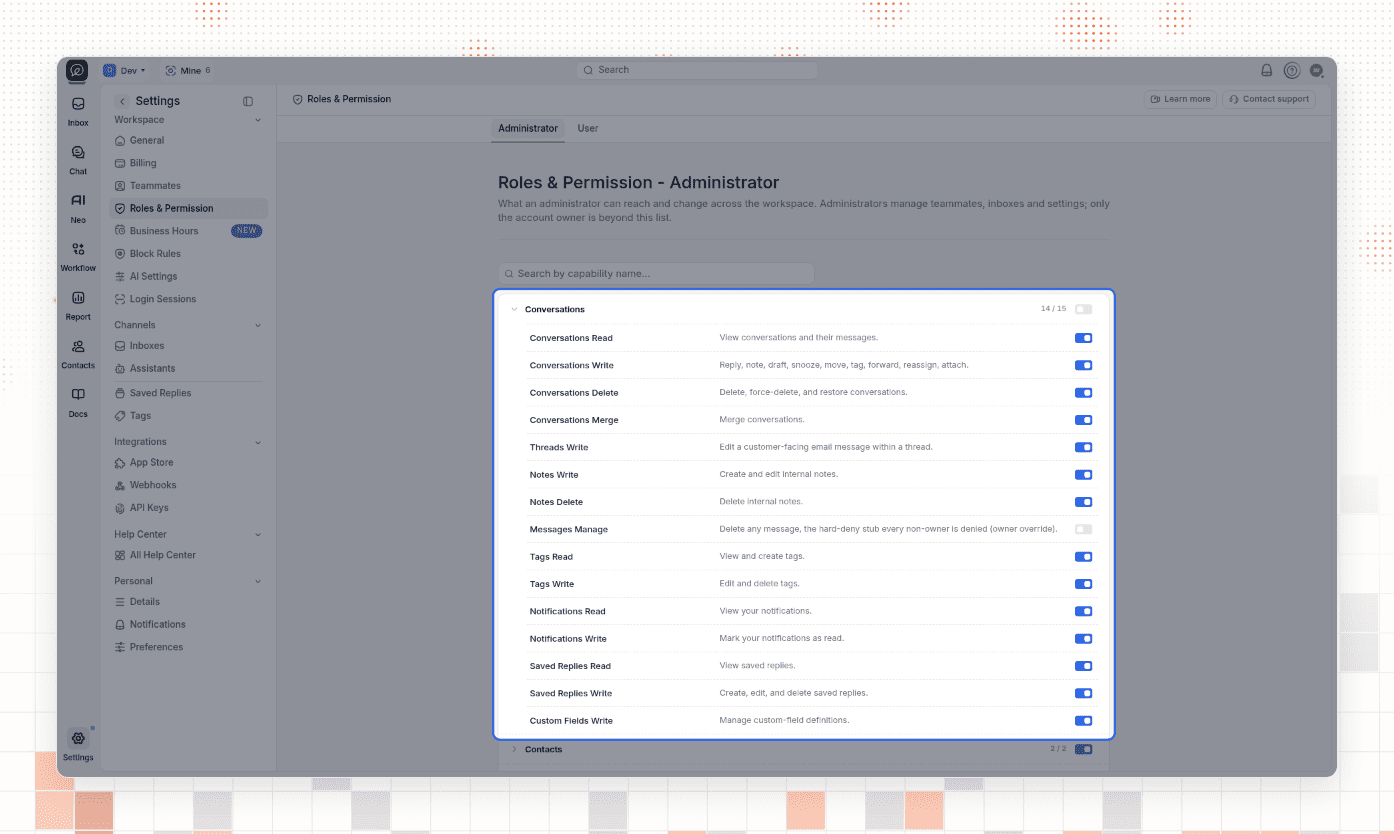
To change a capability, turn the switch on its row on or off. Saving… shows, then the message Capabilities updated appears.
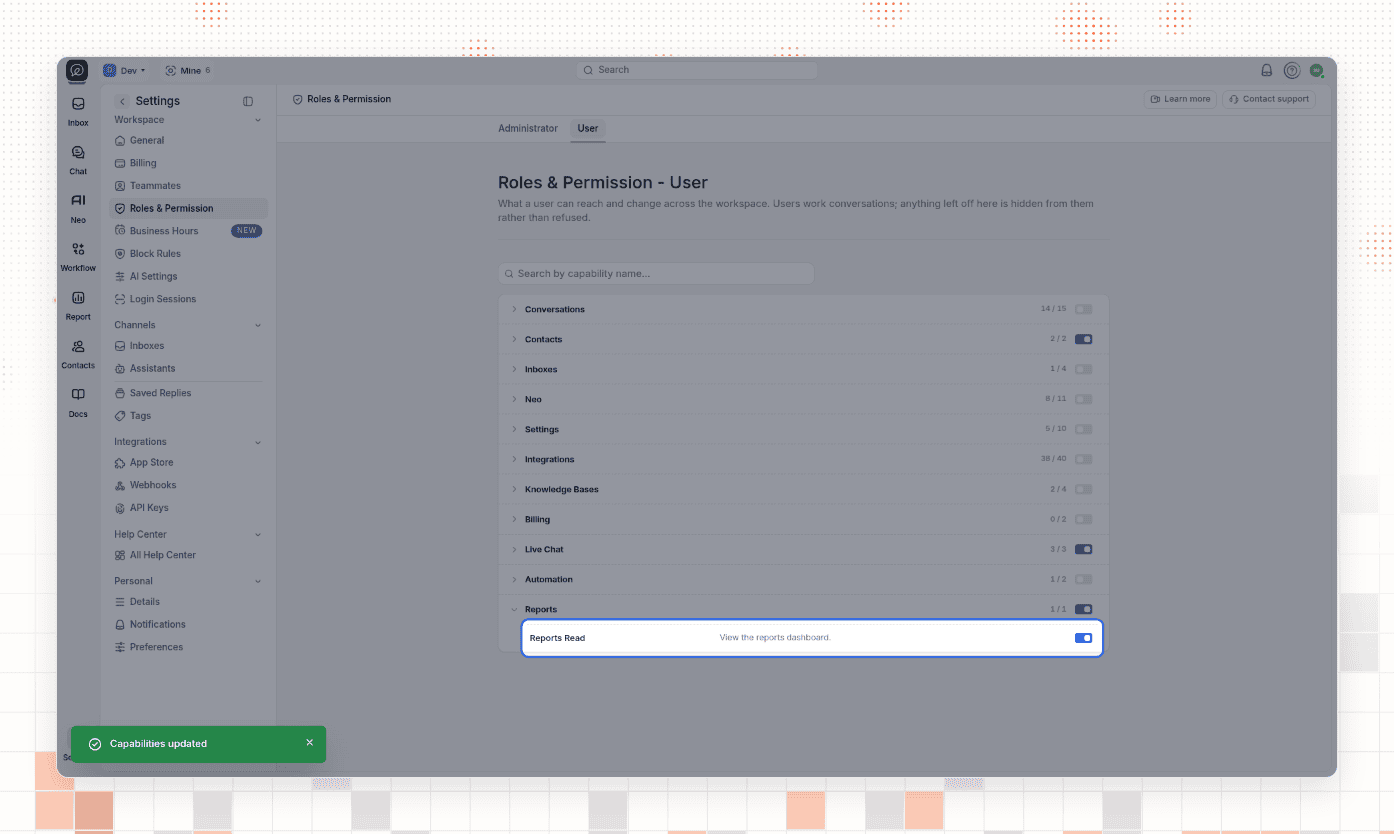
Each category header shows a count, for example 1 / 4. The first number is how many capabilities in the category are on for the role. The second number is how many capabilities the category has. The switch on the header turns on every capability in the category that you can change. When all of them are already on, the same switch turns them all off.
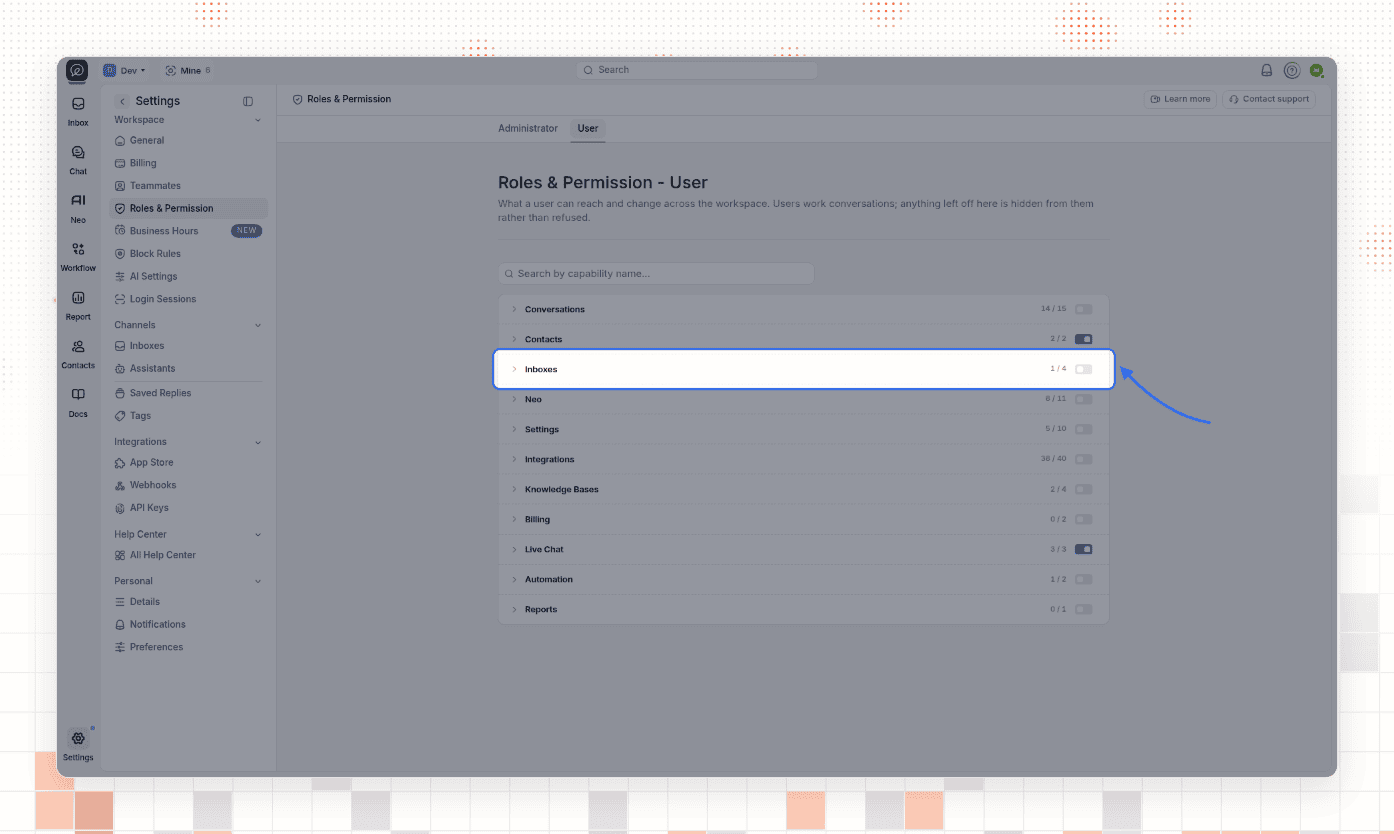
Six capabilities are owner-only: they are off for both roles by default. They are Billing Read and Billing Write in the Billing category, Messages Manage, Inboxes Manage, Users Manage, and Apps Manage. The Account Owner sees these rows on both tabs and can turn them on for a role. ThriveDesk shows no warning. A role change applies to everyone in that role. For example, Inboxes Manage on the User tab lets every User reach the conversations of every inbox, including inboxes where they are not an agent.
Find a capability
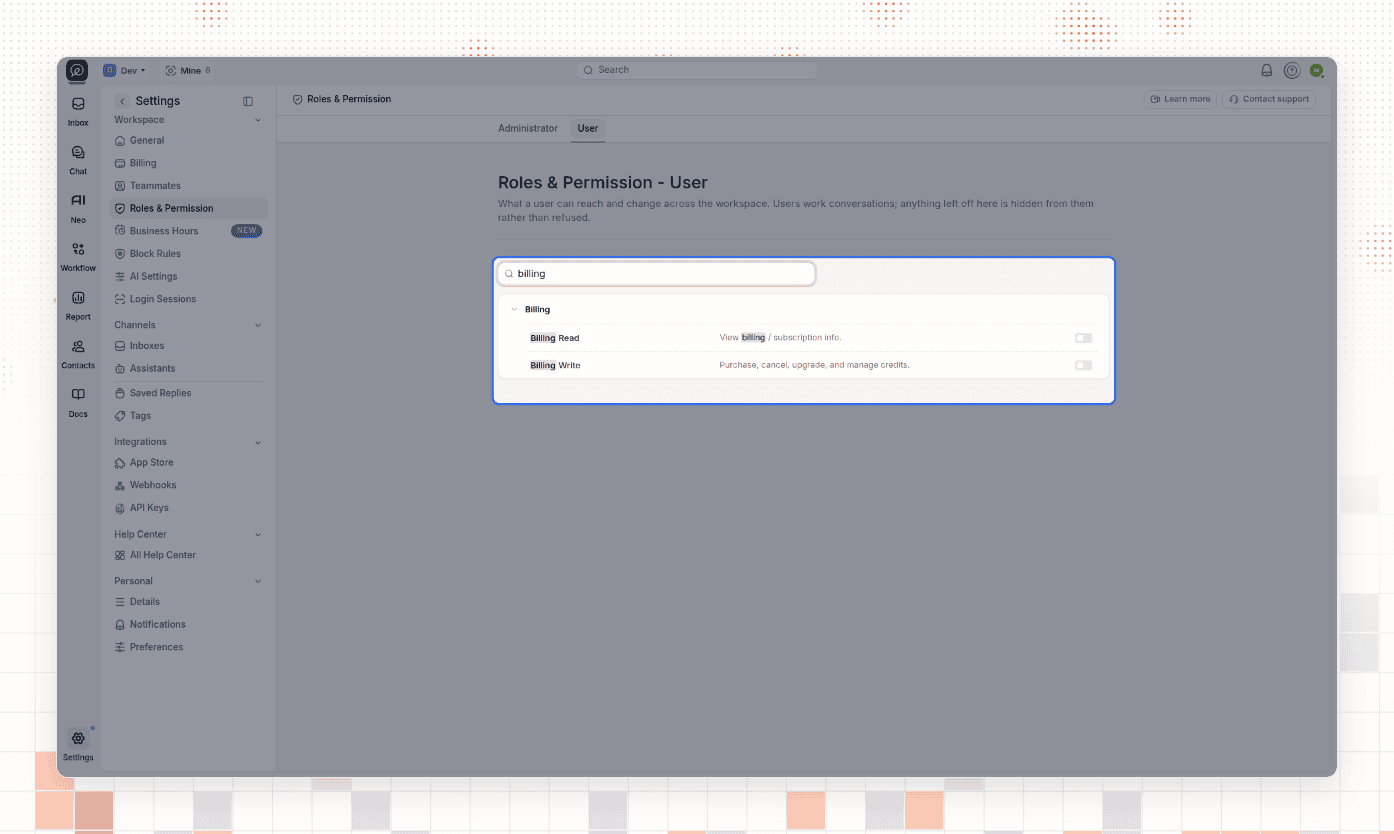
Type a word in the Search by capability name... box. The search checks the name, the description, and the category of each capability. Upper and lower case do not matter. Matching text is highlighted, and every category with a match opens. The counts and the category switches hide while you search. When nothing matches, the page shows No capabilities found.
For example, type billing to show only the Billing category.
What an Administrator sees
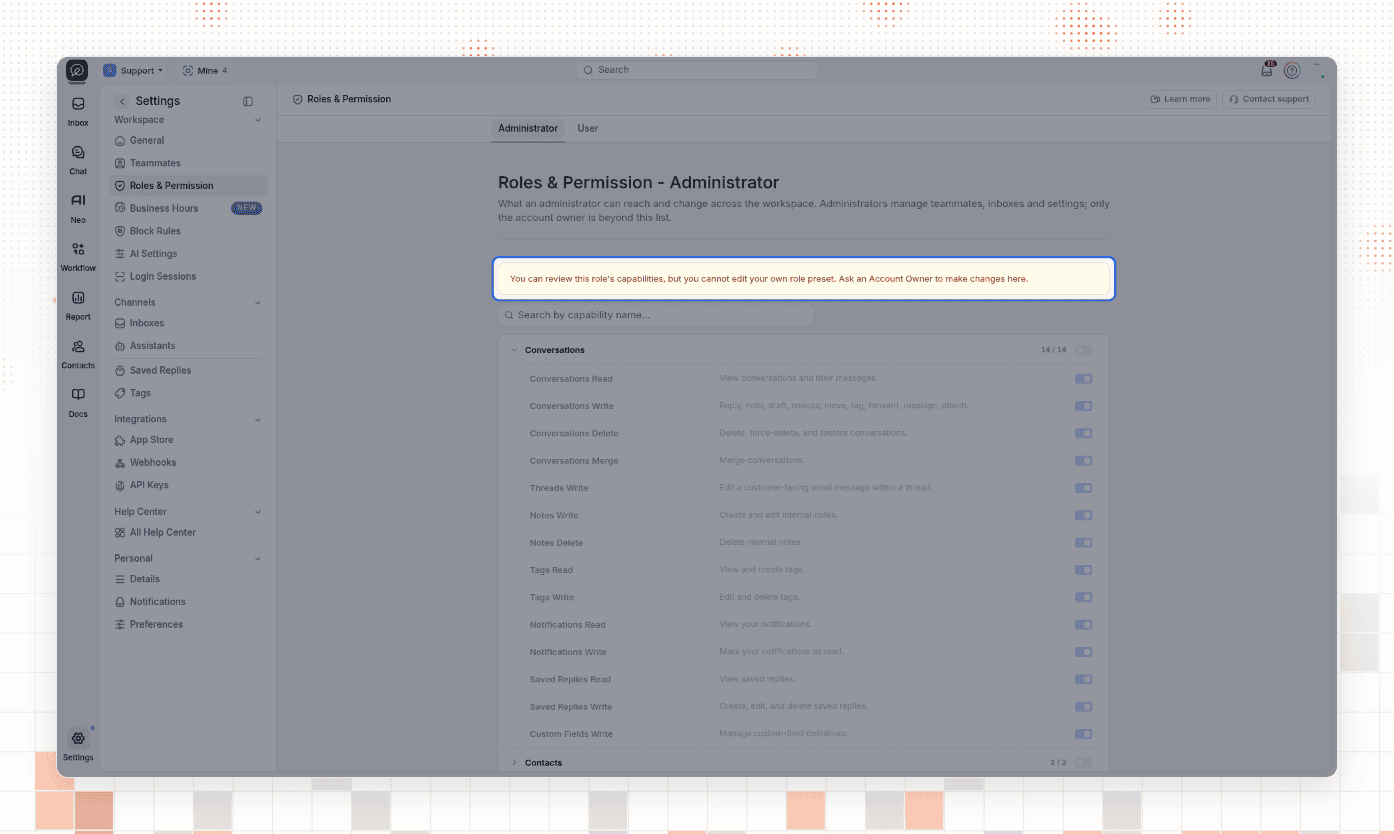
An Administrator can change the User role, but not the Administrator role. On the Administrator tab, an Administrator sees every switch dimmed and this banner: You can review this role's capabilities, but you cannot edit your own role preset. Ask an Account Owner to make changes here.
On the User tab, the switches work for an Administrator. Administrators do not see the six owner-only capabilities on either tab.
Who can open the page
The Account Owner can always open Roles & Permission. Other teammates need the Permissions Write capability, in the Settings category. The Administrator role has Permissions Write by default. The User role does not.
A teammate without Permissions Write does not see Roles & Permission in the Settings sidebar. When that teammate opens the page's address, ThriveDesk shows You do not have permission to view this page and Please contact your organization owner for help.
Change what one teammate can do
A teammate's capabilities start from their role. Use the Capabilities tab on the teammate's profile to give that one teammate more or less than the role.
Go to Settings → Teammates.
Select Manage on the teammate's row. The teammate's profile opens.
Select the Capabilities tab. The tab has the same categories, search, and switches as the Roles & Permission page.
Turn the switch on a row on or off. The change saves at once, and the message Capabilities updated appears.
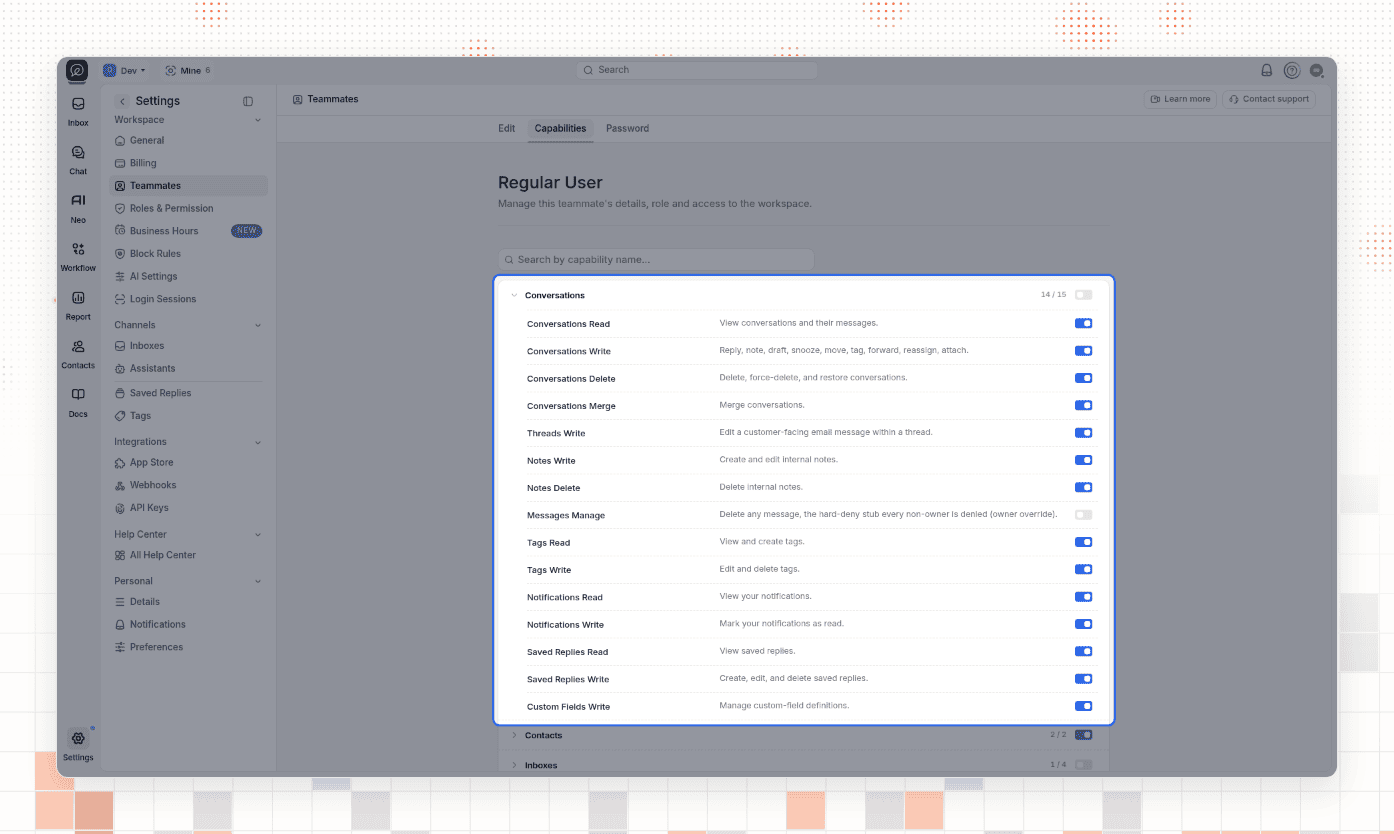
The Capabilities tab shows only to teammates who can open Roles & Permission, and never on your own profile. On the Account Owner's profile, the tab shows Workspace owners always hold every capability. There is nothing to curate here.
Give a teammate a role
When you invite a teammate
Go to Settings → Teammates.
Select Invite teammates. The Invite to your workspace window opens.
Enter the teammate's Email.
Under Role, choose User or Admin. Admin is the Administrator role. User is selected by default.
Under Add teammates to this inbox, select the inboxes for the teammate.
Select Invite teammates. The message Invitation has been sent appears.
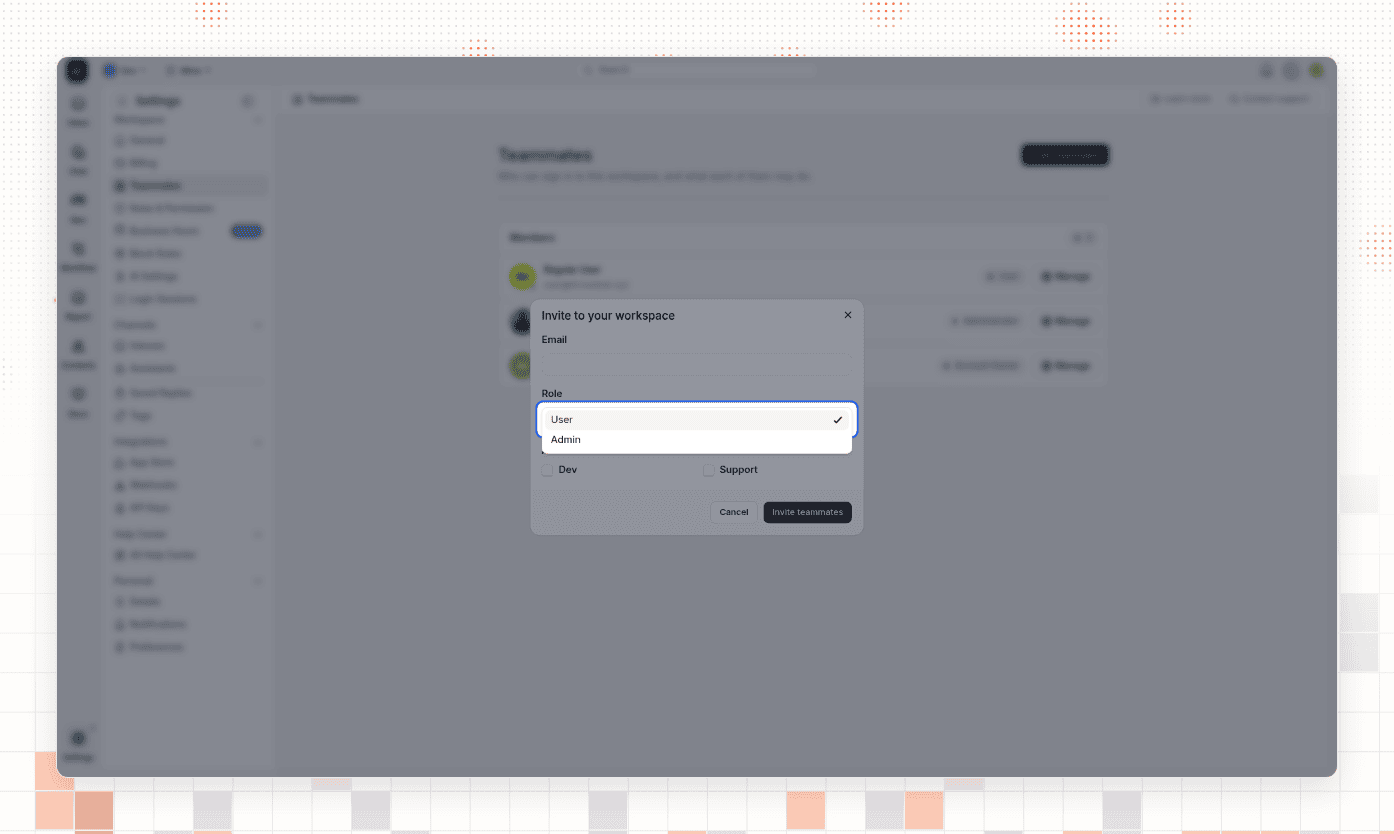
When the teammate accepts the invitation, the teammate joins with the role you chose.
For a teammate who has joined
Go to Settings → Teammates.
Select Manage on the teammate's row.
On the Edit tab, choose User or Administrator in Role.
Select Save Profile. The message User profile has been updated appears.
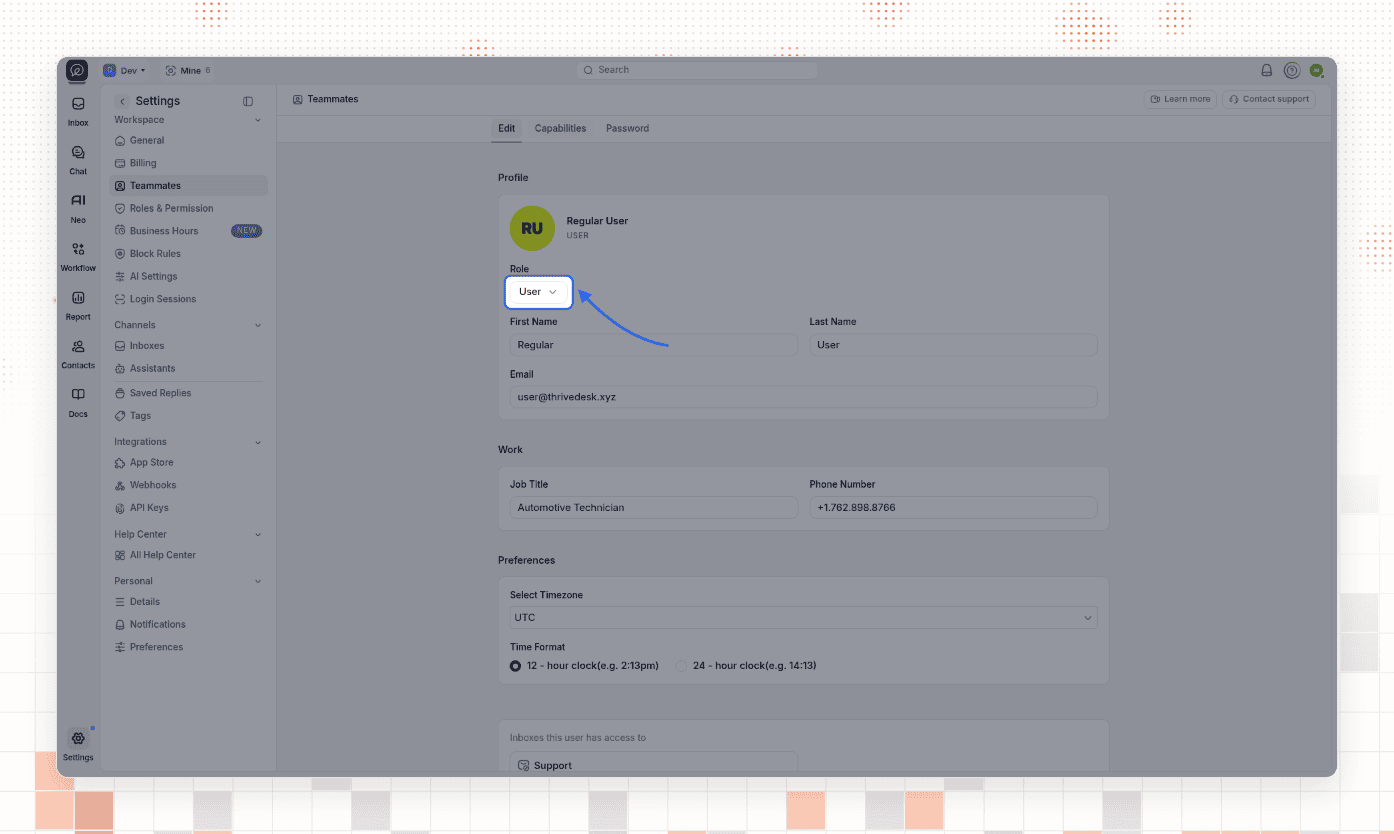
Only the Account Owner and Administrators see the Role select. The table shows who can change whose role.
You are | Change a User's role | Change an Administrator's role | Change your own role |
|---|---|---|---|
Account Owner | Yes | Yes | No |
Administrator | Yes | No | No |
User | No | No | No |
The Account Owner's role cannot change. On the Account Owner's profile, the only Role option is Account Owner.
What you should see
After a change on a role tab, the message Capabilities updated appears, and the count on the category header changes. The change reaches everyone in that role at once: controls appear or disappear for those teammates, and a teammate on a page they can no longer open sees You do not have permission to view this page. Teammates with a personal setting for that capability keep the personal setting.
After a role change on the Edit tab, the teammate's row in Settings → Teammates shows the new role.
Common problems
Symptom | Cause | Fix |
|---|---|---|
A change on a role tab does not reach one teammate | The teammate has a personal setting for that capability. A personal setting wins over the role | Open the teammate's profile, select Capabilities, and switch that row to the value you want |
After you change a teammate's role on the Edit tab, the teammate still has, or still lacks, a capability | Personal settings on the Capabilities tab stay when the role changes | Open the teammate's Capabilities tab, and switch that row to the value you want |
You cannot change the Role select on a teammate's Edit tab | It is your own profile, or you are an Administrator and the teammate is an Administrator | Ask the Account Owner to change the role |
Roles & Permission is missing from Settings, or the page shows You do not have permission to view this page | You do not have the Permissions Write capability | Ask the Account Owner for access |
Questions
Can I make a teammate the Account Owner?
Not from the app. Each workspace has one Account Owner, and the Role options for a teammate are only User and Administrator. To transfer ownership to another teammate, contact ThriveDesk support.
Can I reset a role to its default capabilities?
No. The page has no reset button. To restore a default, turn that switch back.
Does turning on a Write capability also turn on its Read capability?
No. Each switch changes one capability only. For example, turning on Users Write does not turn on Users Read. Check both rows.
Related
Invite teammates — to add teammates to your workspace and see pending invitations. The invitation sets the teammate's first role.
Give a teammate access to an inbox — for the inboxes a teammate is an agent on. Inbox access is a different setting from roles and capabilities, and this article does not cover it.
Set up business hours — the Company Read capability decides who can open the Business hours page.
Last verified: 2026-11-08